
Facts & prices checked: 2026-10-11
Tanzania holds one of the last viable large cheetah populations on Earth. The Serengeti-Mara ecosystem, spanning the Serengeti in Tanzania and the Maasai Mara in Kenya, is one of only two cheetah populations globally that exceeds 1,000 individuals, according to ZSL.
This is the context that makes the Serengeti exceptional not just as a safari destination, but as a conservation site. When you watch a cheetah hunt on the Ndutu plains, you are watching one of the most important wild cheetah populations remaining on the planet. The ZSL research team that monitors this population has been doing so since 1991, and its data is a major part of what science knows about how wild cheetahs live and die.
The global cheetah crisis in numbers
ZSL states that fewer than 7,000 cheetahs remain in the wild worldwide, with 30 known populations in Africa.
Tanzania’s share: Tanzania’s national population was estimated at 569–1,007 individuals in a peer-reviewed assessment from 2001. One Serengeti-focused source puts the Serengeti ecosystem (including the Mara in Kenya) at 1,200–1,500 cheetahs, which makes it one of the most important cheetah landscapes in Africa.
The species is listed as Vulnerable on the IUCN Red List. The effective conservation pressure is arguably worse than the listing suggests, because so much of the remaining range is outside protected areas.
The 77% problem: most cheetahs live outside parks
The single most important fact about cheetah conservation is this: about 77% of free-ranging cheetahs live outside formally protected areas.
This is not incidental. Cheetahs avoid areas with many lions and hyenas, and those are often the parks with the richest wildlife. Many cheetahs push outward, into the communal lands and buffer zones that surround parks.
Out there, the threat changes from predator competition to human-wildlife conflict. A farmer who loses two goats to a cheetah, and whose entire liquid savings may be those goats, has a rational economic reason to retaliate. Poison, snares, and direct shooting all happen. The cheetah’s long territory ranges (usually about 13 to 26 km², up to 130 km²) mean a single animal may move through multiple villages and multiple livestock operations in a week.
This is why conservation efforts that focus only on what happens inside park boundaries are incomplete for cheetahs. The parks protect some of the population. The communal areas around the parks determine what happens to the majority.
The Serengeti Cheetah Project: individual monitoring since 1991
ZSL’s Serengeti Cheetah Project is the longest-running in-depth single-population cheetah survey in Africa. The project has monitored individual cheetahs on the southern Serengeti plains since 1991, though ZSL’s own project sheet says individual cheetahs on the plains have been tracked since 1974.
The method is deceptively simple: cheetahs are identified by their unique spot patterns, which work like fingerprints. Once an individual is documented, researchers can track that animal’s movements, territory, reproductive history, coalition membership, and cause of death across its entire life. This longitudinal data, across hundreds of individuals over decades, produces knowledge about wild cheetah demography that camera traps and short-term surveys cannot replicate.
Key findings from the long-term monitoring:
- The southern Serengeti plains cheetah population has been estimated at approximately 50 adult females and 20 adult males at various monitoring points, a surprisingly small core population considering the Serengeti’s size
- Male cheetah territories are usually about 13 to 26 km² and can extend to about 130 km²
- The project has tracked vehicle-related cheetah deaths and launched a “Kill Your Speed” campaign after several years of cheetah road mortality on Serengeti roads
The project’s long-term data feeds a large share of the published research on cheetah population dynamics and cub survival.
Cub mortality: the hardest number
About 90% of Serengeti cheetah cubs die before one month of age. The figure comes from long-term monitoring and is extraordinary even for a large carnivore.
The causes are specific:
Lion predation is a primary driver. Lions kill cheetah cubs whenever they find them, which is competition between predators in its most direct form. A mother cheetah cannot defend cubs against a lion and will flee; the cubs are left exposed. This pressure explains why cheetah mothers move cubs continuously, sometimes daily, in the early weeks, a behaviour that makes very young cubs almost impossible to observe in the field.
Starvation via kleptoparasitism is the indirect killer. When a mother cheetah’s kills are repeatedly stolen by larger predators, she cannot eat enough to sustain lactation, and the cubs weaken. Open terrain gives competitors a clear view of the carcass, and a cheetah recovering from a sprint is vulnerable.
When a safari vehicle stops to watch a cheetah mother with older cubs, those cubs are survivors. They have cleared the most dangerous phase of their lives. The family unit that looks relaxed, cubs play-fighting while the mother scans for Thomson’s gazelles, represents the fraction that made it through the 90% mortality window.
The cheetah as a daytime hunter: biology and behaviour on the game drive
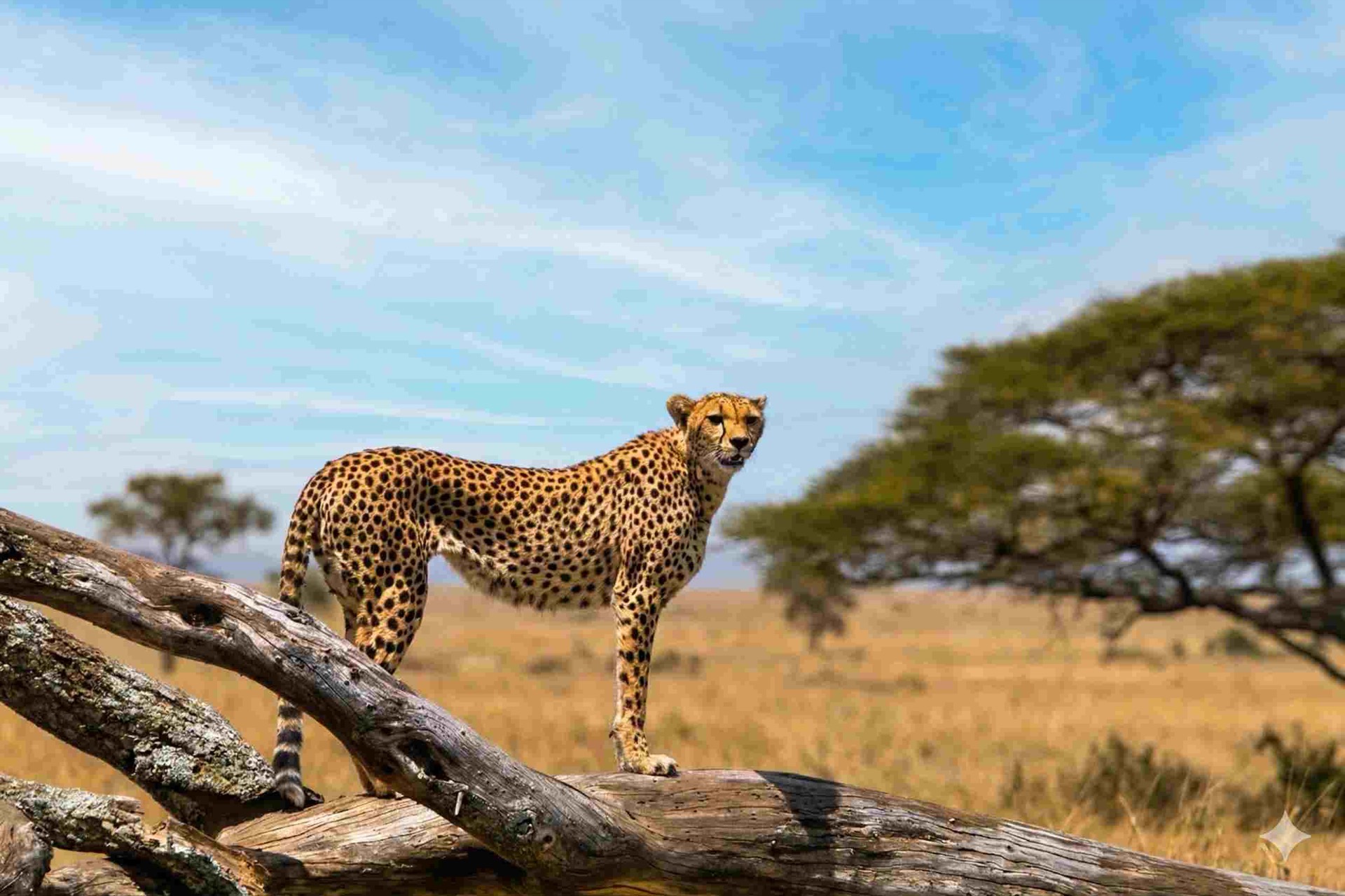
Cheetahs are primarily daytime hunters, and they use daylight, especially dawn and dusk, to reduce competition from larger predators.
Understanding this shapes what to expect on a game drive:
- Dawn departures matter. Early morning and the hours before midday are the best time to look for a stalk or chase, since cheetahs hunt mainly in daylight.
- The sprint is short. At full speed a cheetah reaches approximately 110 km/h, the fastest land mammal on Earth, but can maintain that pace for only about 300 yards before overheating forces it to stop. Successful hunts depend on closing distance silently, not outlasting the prey.
- Recovery time is vulnerability. After a sprint a cheetah needs to recover before eating, and larger predators often steal kills. If your vehicle is watching a cheetah that just made a kill, expect the meal to be contested.
The Ruaha Carnivore Project: the community-conservation model
The Ruaha Carnivore Project (RCP) works around Ruaha National Park in southern Tanzania, in partnership with the University of Oxford’s WildCRU (Wildlife Conservation Research Unit), to reduce conflict between local communities and carnivores. Retaliatory killing after livestock predation is a major threat to cheetahs outside protected areas.
The project is reported to have reduced killings of lions, leopards, cheetahs, and African wild dogs by 80% in its core study area after working there for more than a decade (a single-source figure). The Ruaha-Rungwa ecosystem covers approximately 50,000 km², and a peer-reviewed study has confirmed cheetahs there, though the population is less well documented than the Serengeti’s.
Where to see cheetahs in Tanzania: the zones that deliver sightings
Tanzania’s best cheetah sightings are concentrated in open-grass plains where prey density and visibility are both high. The Serengeti ecosystem leads, with meaningful secondary populations in the south.
Namiri Plains (eastern Serengeti): Identified by safari operators as excellent for cheetah sightings. The Asilia camp there lists rates from USD 740 per person per night in low season.
Ndutu and the southern Serengeti plains: The January to March calving season is the best window. Cheetahs are resident year-round, but sighting density is highest on the southern plains (Ndutu, Naabi) when prey is abundant and the grass is short.
Ruaha National Park (southern Tanzania): The Ruaha-Rungwa ecosystem is one of Tanzania’s significant secondary cheetah landscapes. Sightings are less frequent than in the Serengeti, but the ecosystem’s scale and reduced visitor pressure make it an important option for travellers already planning southern Tanzania.
The most effective single itinerary for cheetah probability: fly to Ndutu or the southern Serengeti between January and March, then consider moving to the Namiri Plains zone.
What a safari visit contributes
Conservation fees paid to enter Tanzania’s national parks go to the authority that manages the parks where cheetahs live. Serengeti National Park entrance fees (currently USD 82.60 per adult per day) flow to TANAPA. ZSL describes its cheetah work as carried out with the support of the Tanzanian authorities and in collaboration with TAWIRI and TANAPA.
In Wildlife Management Areas (WMAs), the community conservation zones around parks, entrance fees for adults have been reported at USD 10, and that revenue can give villages a direct financial reason to maintain habitat rather than convert it to agriculture. The more valuable wildlife is alive and observable by visiting tourists, the stronger the economic case for conservation over competing land uses.
Road mortality inside the Serengeti: the man-made threat
The primary threats to cheetahs in Tanzania are human-wildlife conflict outside parks and lion predation inside them. Inside the Serengeti, a third threat has emerged from within the conservation infrastructure itself: vehicle speed on park roads.
The Serengeti Cheetah Project launched a “Kill Your Speed” campaign after several years in which cheetahs were killed by speeding vehicles on Serengeti roads.
Serengeti roads cross the open plains that cheetahs use for hunting, and unfenced roads mean wildlife crosses without warning. Safari operators who set their own speed standards, and drivers who keep to them, are part of the solution.
This is one area where visitor behaviour inside the park has a direct effect. If your driver is travelling fast between game-drive locations, ask them to slow down.
→ Related guides: Tanzania cheetahs: where to see them and the best season · Tanzania wildlife conservation: elephants, rhinos, and what works · Serengeti calving season: January and February at Ndutu · Serengeti National Park guide: zones, seasons, and planning · Tanzania wild dogs: where to find African painted wolves · Tanzania safari costs: full budget breakdown
Frequently asked questions
How many cheetahs are left in Tanzania and the world?
ZSL states that fewer than 7,000 cheetahs remain in the wild worldwide, spread across 30 known populations in Africa. Tanzania's national population was estimated at 569–1,007 individuals in a peer-reviewed 2001 assessment. One Serengeti-focused source puts the ecosystem at 1,200 to 1,500 cheetahs (a figure that includes the Kenyan Maasai Mara). ZSL says only two cheetah populations worldwide remain above 1,000 animals.
What is the Serengeti Cheetah Project?
The Serengeti Cheetah Project is a long-term research programme run by ZSL (Zoological Society of London) that has monitored individual cheetahs on the southern Serengeti plains since 1991, making it the longest-running in-depth single-population cheetah survey in Africa. Researchers identify individual animals by their unique spot patterns, which remain stable throughout life, and record movements, territory sizes, reproductive success, coalition membership, and cause of death. The project has kept track of individual cheetahs on the southern plains since 1974, which has produced a very detailed long-term dataset on wild cheetah demography. Much of what is known about cheetah cub mortality, coalition behaviour, and kleptoparasitism pressure comes from this project.
Why do so many cheetah cubs die in the Serengeti?
About 90% of Serengeti cheetah cubs die before one month of age: a figure driven by predators and kill theft. Lion predation is a primary killer: lions kill cheetah cubs when they find them, and a mother cheetah cannot defend her cubs against a lion. Kleptoparasitism pressure is the indirect cause: when a mother's kills are repeatedly stolen by hyenas or lions, she cannot produce enough milk to sustain the cubs and may abandon the den. Mothers move cubs frequently, sometimes daily, to avoid detection, and sightings of very young cubs in the field are rare precisely because of this concealment behaviour.
What percentage of cheetahs live outside protected areas and why does it matter?
About 77% of free-ranging cheetahs live outside formally protected areas, on communal land, private farms, and in buffer zones between parks. This is unusually high for a large carnivore. It happens because cheetahs need large open territories (male territories are usually about 13 to 26 km² and can reach 130 km²), avoid areas of high lion and hyena density (which parks often have), and follow prey into communal areas around park boundaries. Living outside parks exposes cheetahs to human-wildlife conflict: farmers who lose goats or calves to cheetahs may retaliate with poison, snares, or direct killing. This is why community-based conservation programmes, not just park enforcement, are essential for cheetah survival.
How does the Ruaha Carnivore Project protect cheetahs?
The Ruaha Carnivore Project (RCP), operated around Ruaha National Park with the University of Oxford's WildCRU (Wildlife Conservation Research Unit), directly targets the human-wildlife conflict that kills cheetahs outside protected areas. The project has worked for more than a decade to reduce conflict between local communities and carnivores. It is reported to have reduced killings of lions, leopards, cheetahs, and African wild dogs by 80% in its core study area.
Does visiting Tanzania on safari contribute to cheetah conservation?
Yes, in two direct ways. Conservation fees paid at Serengeti National Park (currently USD 82.60 per adult per day) go to TANAPA, which runs the park. In community areas around parks, safari revenue flowing to Wildlife Management Areas gives villages a financial reason to protect habitat rather than convert it to farmland.
What is the best time of year to see cheetahs in the Serengeti?
Cheetah sightings in the southern Serengeti and Ndutu area are at their densest during the January to March calving season, when prey is abundant and the grass is short. Cheetahs are resident in the Serengeti year-round, and Namiri Plains in the eastern Serengeti is identified as excellent for cheetah sightings. Cheetahs hunt mainly in daylight, so dawn and the morning hours are the best time to look for a stalk or chase.
Are there cheetahs in Tanzania's southern parks, or only the Serengeti?
A significant cheetah population exists in the Ruaha-Rungwa ecosystem in southern Tanzania, a conservation complex covering approximately 50,000 km². The Ruaha Carnivore Project operates there specifically to reduce the human-wildlife conflict that kills cheetahs outside protected areas. Sightings in Ruaha National Park are less frequent than in the Serengeti, and the population is less well-documented, but the ecosystem is one of Tanzania's important secondary cheetah landscapes well beyond the northern circuit.
Sources and last verified
- ZSL Serengeti Cheetah Project (Darwin Initiative project sheet): Shows ZSL's study since 1991, individual tracking on the southern plains since 1974, and about 50 adult females and 20 adult males.
- Cheetah Conservation Initiative: Serengeti Cheetah Project: Describes the Serengeti Cheetah Project and its Kill Your Speed campaign.
- Lion Landscapes: Ruaha programme: Lists Ruaha, Tanzania as a programme area with livestock protection work.
.