
Facts & prices checked: 2026-10-11
Tanzania’s Serengeti ecosystem is one of the best places to watch a cheetah in open daylight, from a stationary vehicle, with a clear view across short-grass plain. No other big cat is as easy to watch. Leopards move at night and rest invisible in trees. Lions ambush from long grass. Cheetahs sprint across open ground in full sun. If you time it right, the only limit on what you see is the speed of the cat.
Tanzania’s cheetahs: the most observable big cat
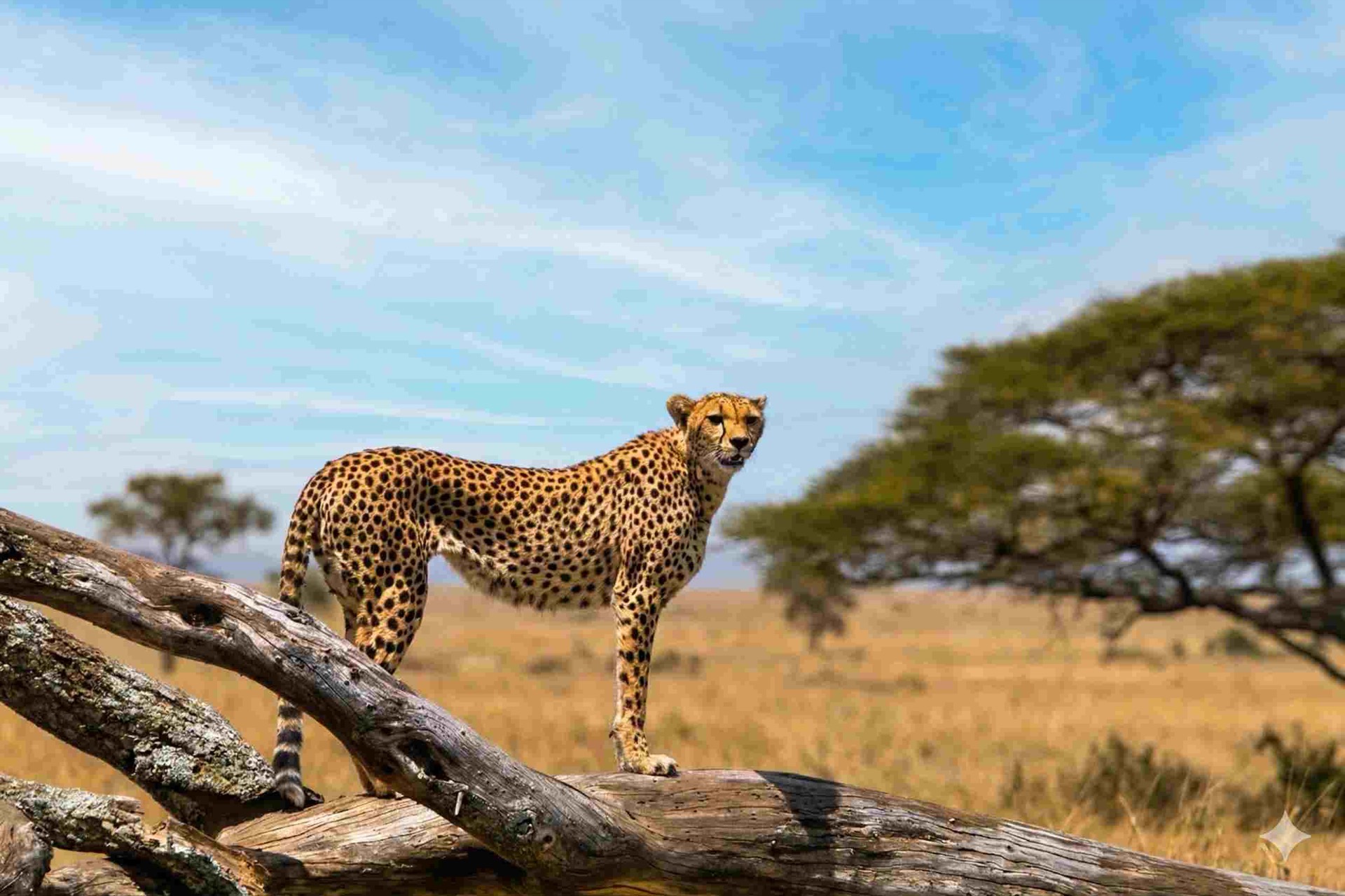
The single most important thing to understand about cheetahs is that they are diurnal, active during daylight hours. This separates them from every other large predator in Tanzania. Lions and leopards are primarily nocturnal and crepuscular; you see them at dawn or dusk, resting through the middle of the day. Cheetahs hunt in the morning light and again in the late afternoon, using visual cues, long sightlines across the plains, rather than cover and darkness.
This diurnal behaviour, combined with their preference for open short-grass habitat, makes them the most observable big cat on a standard game drive. A cheetah on a termite mound scanning the horizon at 08:00 in the Ndutu area is visible from a long way off. A leopard at the same hour is almost certainly asleep in a fever tree and invisible unless your guide already knows the tree.
Cheetahs are also not true “big cats” in the Panthera genus. They belong to their own genus, Acinonyx jubatus, a distinction that explains a lot about their biology. They cannot roar; instead they chirp, purr, and make high-pitched calls that sound almost bird-like. Their claws are semi-retractable rather than fully retractable, which gives them traction during high-speed pursuit at the cost of tree-climbing ability. They are built entirely around speed and the open landscape, a cat for the plains, not the forest.
Tanzania holds a critical share of the world’s remaining cheetahs. According to ZSL (Zoological Society of London), fewer than 7,000 cheetahs remain in the wild worldwide. The Serengeti-Mara-Tsavo landscape is one of only two cheetah populations that exceed 1,000 animals, which makes it one of the species’ most important strongholds.
Serengeti: Tanzania’s cheetah heartland
Published estimates put the Serengeti ecosystem at roughly 1,200–1,500 cheetahs, one of the largest populations in Africa. Within the park proper, estimates range from 500 to 1,000 individuals depending on the source. The Serengeti Cheetah Project has monitored individual cheetahs on the southern plains since 1974, and ZSL has run it since 1991, the longest-running in-depth single-population cheetah survey in Africa. Researchers identify individual animals by their unique spot patterns.
The habitat explains the density. The Serengeti’s southern short-grass plains are volcanic, mineral-rich grassland that supports enormous herds of Thomson’s gazelle year-round, the cheetah’s primary prey. The open terrain gives cheetahs the long sightlines they need to stalk and sprint, and removes the cover that would allow larger predators to approach undetected. Lions and leopards both steal cheetah kills frequently; on open plains, a cheetah has at least some warning before losing a meal.
Year-round sighting zones within the Serengeti:
- Naabi Hill area: One of the most consistently productive cheetah zones in the park. The rocky outcrops give cheetahs elevated vantage points for scanning, and the surrounding short grass allows open viewing from vehicles. A slow drive through this area at any time of year has a reasonable chance of a cheetah sighting.
- Simba Kopjes (central plains): The granite kopje formations here serve the same function: platforms for scanning, shade for resting cubs, and open grassland below for hunting.
- Seronera Valley: The central hub of the park. The resident big-cat density around Seronera is exceptional year-round, and cheetahs are regularly sighted on the open sections flanking the riverine forest.
- Southern short-grass plains (Ndutu area): Transformative during calving season (see below), but productive for cheetahs in any month where the short-grass extends across the terrain.
For a detailed comparison of these zones by month, vehicle pressure, and price (Ndutu’s January–February calving window, Namiri Plains’ low-traffic concession, and Seronera’s year-round reliability) see the Serengeti cheetah zones guide.
Male coalitions, groups of 2–4 brothers who stay together permanently, are a regular sighting across all these zones. They hold territories across the plains, cooperate on larger prey, and are significantly more willing to take on wildebeest calves and young topi than a solitary male would be.
Ndutu in calving season: the best cheetah window
Mid-January to February is when the Ndutu area becomes something different: not just a good cheetah sighting, but a concentrated, daily, multi-family viewing experience.
During the wildebeest calving season, hundreds of thousands of calves are born on the southern Serengeti and Ndutu plains in a compressed window, peaking in February. The calves are slow, abundant, and spread across open terrain, exactly the prey conditions that favour cheetahs. Mothers with cubs move to Ndutu for the calving. Male coalitions follow the prey density. Cheetahs gather on terrain that allows unobstructed viewing from vehicles.
What you see at Ndutu in February:
Hunting sequences in full. The walk-stalk-sprint hunting cycle that cheetahs use is visible across flat plains without any obstruction. You can see the stalk from 300 metres away, read the cheetah’s body posture as she singles out a target, and watch the sprint begin.
Mothers teaching cubs. Older cubs watch and sometimes join in on hunts while the mother makes the kill and the cubs approach cautiously. These teaching sequences are among the more complex predator behaviours visible from a safari vehicle.
Coalition males on large prey. When two or three coalition brothers hunt together, they can bring down larger prey, young wildebeest calves, impala, occasionally smaller topi. A coordinated coalition hunt on the open Ndutu plains, three brothers working in formation, is one of the most dramatic predator spectacles in Tanzania.
Speed. The Ndutu short-grass terrain is flat and open. When a cheetah runs, the full sprint is visible from start to finish. Cheetahs have been timed at 110 km/h in the field, the world’s fastest land animal, and can hold top speed for only about 274 metres.
The best camps and lodges for calving-season viewing are in the Ndutu area, south of the Serengeti boundary in the Ngorongoro Conservation Area. Most are small, seasonal camps or mobile operations that set up specifically for the January–March window.
Coalition males: when brothers hunt together
Male cheetah coalitions are one of the most extraordinary relationship structures in the African predator community. Brothers from the same litter, typically 2–4 animals, sometimes stay together permanently after reaching adulthood. These coalitions function as stable units: they hold shared territories, coordinate on hunts, and rarely separate.
The hunting advantages are significant. A single male cheetah is restricted to prey he can bring down alone, mainly Thomson’s gazelles. A coalition of brothers can work together to take down larger prey such as young wildebeest or topi.
The Serengeti Cheetah Project identifies individual cheetahs by spot pattern and has tracked them over many years.
From a viewing standpoint, a coalition hunt on open Serengeti terrain is specifically valuable because you can see the entire sequence, from the brothers fanning out around a target to the moment one makes contact. This is in contrast to leopard or lion hunts, which typically happen in long grass, at night, or in terrain that obscures the crucial moments. Cheetah coalition hunts, on short-grass plains in morning light, are readable.
Cheetah hunting technique: what you are watching
Understanding the hunting sequence makes the observation significantly more interesting. Cheetahs do not ambush in the way that leopards do. They stalk openly across the plains, using whatever elevation is available (a termite mound, a low kopje rock) to scan ahead before descending into a deliberate approach.
The full sequence:
Elevated scanning. A cheetah on a termite mound is already in hunting mode, scanning for prey, assessing distances, selecting a target. The cat appears relaxed but is working: identifying isolated animals, weak individuals, prey that has not yet noticed the cheetah.
The stalk. The cheetah descends and approaches the prey herd in a low, deliberate walk. She uses grass, terrain undulation, and the prey’s movement (when prey faces away, she moves; when they look up, she freezes) to close the gap. The approach often takes longer than the sprint.
The sprint. When the distance is short enough, the cheetah breaks into a full sprint. She has been timed at 110 km/h in field conditions, and she can hold top speed for only about 274 metres, so the chase has to be short.
The recovery. After a sprint, a successful cheetah has to rest and recover before she can eat. During this window, lions, hyenas, and vultures can approach, and cheetahs rarely defend a kill against larger predators. Kill theft (kleptoparasitism) is a significant pressure: cheetah kills are often lost to bigger predators.
This is why cheetahs eat fast. Once rested, they consume what they can, quickly, before competitors arrive.
Ngorongoro Crater and other parks
The Ngorongoro Crater has a small resident cheetah population, but sightings are less reliable than the Serengeti and the dynamics are different. The crater floor has very high densities of lions and spotted hyenas, which puts heavy pressure on the cheetah population. Much of the prey base on the crater floor consists of larger animals that suit lions more than cheetahs.
Ngorongoro is worth including in a Tanzania itinerary for many reasons, but cheetah viewing specifically is not one of them. The Serengeti, and especially Ndutu during calving, is clearly better.
Tarangire National Park has cheetah sightings, particularly in the more open southern sections where the woodland thins out onto grassland. The habitat is less ideal than the Serengeti short-grass plains, the woodland gives prey more cover and limits sightlines, and cheetah densities are lower. If your itinerary includes Tarangire primarily for elephants and baobabs (its main draw), a cheetah sighting is a bonus, not an expectation.
Ruaha National Park in Tanzania’s southern circuit covers a vast area (approximately 50,000 km² in the wider Ruaha-Rungwa ecosystem) and holds cheetahs; a peer-reviewed study in the African Journal of Ecology confirmed the population. For cheetah viewing as a primary objective, Ruaha is a distant second to the Serengeti.
Cheetah natural history
A few facts that change how you observe cheetahs in the field:
Size. Cheetahs are significantly lighter than lions or leopards, the lightest of Africa’s large cats. Their build is entirely optimised for speed: deep chest for lung capacity, long legs for stride length, semi-retractable claws for grip, a flexible spine that extends the stride. Everything else (strength, climbing ability, stamina) is traded away.
Conservation status. The IUCN lists cheetahs as Vulnerable. Fewer than 7,000 remain in the wild globally. About 77% of free-ranging cheetahs live outside protected areas. The Serengeti population is therefore important at the species level.
Cub mortality. About 90% of Serengeti cheetah cubs die before three months of age. When you see a mother with cubs in the field, the cubs have already survived the most dangerous phase of their lives.
The Serengeti Cheetah Project. Researchers have tracked individual cheetahs on the southern Serengeti plains since 1974, and ZSL has run the project since 1991. Animals are identified by spot pattern. For the full picture on cub mortality, the 77% outside-protected-areas problem, the Ruaha Carnivore Project’s 80% reduction in carnivore killings, and how safari fees fund cheetah protection, see the Tanzania cheetah conservation guide.
Photography and practical tips
The Serengeti’s short-grass plains provide conditions for wildlife photography that are difficult to match anywhere else. A cheetah sprint on flat terrain, in morning light, visible from 200 metres: this is the sequence photographers travel specifically to capture.
The first light window matters. Cheetahs are primarily daytime hunters, and the early-morning light on the Ndutu plains is warm and directional, which suits photography better than harsh midday light. Plan game drives to be out at first light.
For a moving cheetah: Photographers recommend a shutter speed of about 1/2500 to 1/3200 sec for a running cheetah. Pre-set burst mode and continuous autofocus before the vehicle arrives near a stalking cheetah. One wildlife photographer reports best results with a 500mm lens and prefers 600mm when available.
For a stationary cheetah: Get as low as possible. Getting down to eye level improves the composition. A beanbag on the door frame helps keep the camera steady.
Vehicle positioning on a hunt. If your guide reads a stalk in progress, the right position is beyond the prey, not behind the cheetah. The prey then runs toward you with the cheetah behind it, and you get the sprint in frame. Work with an experienced local guide.
Respect distances. The Serengeti Cheetah Project launched a “Kill Your Speed” campaign after several years in which cheetahs were killed by speeding vehicles. Responsible operators keep their distance, turn off engines near cubs, and never crowd a hunting cat. Ask your guide how many vehicles at one sighting is too many.
→ Related guides: Serengeti National Park, zones, seasons, and how to plan · Tanzania lions guide. Serengeti prides and Ngorongoro crater lions · Tanzania leopards guide, where and when to find them · Tanzania safari costs, camp fees and TANAPA rates by park · Tanzania northern circuit, park sequence and logistics · Ngorongoro Crater, fees and what you see · Tanzania safari photography guide, kopje positioning, migration crossings, camera technique · Tanzania wildlife photography guide, equipment, light, and park strategies including cheetah action technique · Tanzania wildlife guide. Big Five locations, wild dogs, and endemic species
Frequently asked questions
Where is the best place to see cheetahs in Tanzania?
The Serengeti's short-grass plains are Tanzania's best cheetah destination; the open habitat suits cheetahs' diurnal, sprint-based hunting style and gives you clear sightlines across large distances. Within the Serengeti, the Ndutu area (southern Serengeti, bordering the Ngorongoro Conservation Area) is the single best location in January–February when wildebeest calving concentrates prey and predators. Year-round, the central Serengeti (Seronera area) and the short-grass plains around Simba Kopjes and Naabi Hill are reliable. The Ngorongoro Crater has cheetahs but lower density than the Serengeti.
When is the best time to see cheetahs in Tanzania?
January and February at Ndutu is the best window for cheetah sightings in Tanzania. The wildebeest calving season brings hundreds of thousands of calves to the southern Serengeti plains, slow, abundant prey that brings cheetah families into open habitat in high density. You can watch hunts, see cubs learning to chase prey, and observe coalition males taking down larger calves, all on flat, open ground from a stationary vehicle. Cheetahs are visible year-round in the Serengeti; the calving season is a concentration event that improves the odds.
How fast do cheetahs run?
Cheetahs have been timed at 110 km/h in the field and are the world's fastest land animals. The sprint is short: cheetahs can maintain top speed for only about 274 metres (300 yards). After the chase a cheetah has to recover before eating, and that window is when larger predators can steal the kill. Kill theft by bigger predators is a regular pressure on cheetahs.
What are male cheetah coalitions and are they common?
Male cheetahs sometimes form permanent coalitions of 2–4 brothers (usually littermates from the same family) that stay together for life. These coalitions cooperate to hold territories and bring down larger prey than a single male could manage, including topi and young wildebeest. Coalition hunts on the open Serengeti plains are among the most dramatic predator sequences in Tanzania safari: coordinated, fast, and visible from a vehicle because they happen in open grassland. Coalition males are commonly sighted in the Serengeti, where researchers track individual cheetahs by their spot patterns.
Are cheetahs easier to see than leopards?
Significantly easier, for one key reason: cheetahs are diurnal (active during daylight hours) while leopards are primarily nocturnal and crepuscular. A cheetah on the open Serengeti plains in morning light is visible from hundreds of metres away. A leopard resting in a tree during midday is effectively invisible unless you already know the tree. Cheetahs also live in more open habitat (short-grass plains) than leopards (woodland, riverine forest), which makes spotting them easier. For guests who rank predator sightings highly, the Serengeti short-grass plains in January–February are the strongest cheetah-viewing option in northern Tanzania.
Is Ndutu worth visiting specifically for cheetahs?
Yes. Ndutu in January–February is the best window for cheetah observation in Tanzania. Open short-grass plains, the wildebeest calving density and resident cheetah families make for excellent viewing. Beyond cheetahs, Ndutu in calving season offers hyena hunts, lion prides with young cubs, and jackals: the entire predator guild is active. Most Ndutu-specific safaris are organized as private mobile camps or small permanent camps bordering the Ndutu lake system; the area is within the Ngorongoro Conservation Area and accessed from the southern Serengeti.
Sources and last verified
- ZSL: Cheetah Conservation in Africa: Fewer than 7,000 cheetahs worldwide; only two populations above 1,000 animals (page blocks automated checks).
- Cheetah Conservation Initiative: Serengeti Cheetah Project: Individual identification by spot pattern, long-term plains study and the Kill Your Speed campaign.
- Smithsonian's National Zoo: Cheetah: Top speed held for only about 300 yards (274 m); about 90 percent of Serengeti cubs die before three months.
- Darwin Initiative: Serengeti Cheetah Project fact sheet: Monitoring of Serengeti cheetahs since 1974; ZSL involvement since 1991.
.